
Well, that depends on who you ask!
 Bees are amazing creatures. They’re incredibly specialized and important creatures. From the second they’re born to the second they die (about six weeks in season), they have one focus: serve the colony. Over their lifetimes, they perform an range of jobs, finishing out their short lives collecting nectar, pollen and water for the hive. They’re such compulsive foragers that it’s literally possible for them to entirely fill their nest with honey and have to move on.
That’s why beekeepers able to collect some of that stored honey.
The trick is not taking so much that you leave them without enough to survive the winter. In our area, an colony of honeybees needs quite a lot of honey to survive: on the order of 30 kg. Generally, as long as you keep that number in mind during the summer, and make sure that you leave them at least that much when you harvest, they’ll do well over the winter and be raring to go the next Spring. Generally. A strong colony can quite easily store 2-3 times that over a season.
We do things differently
We approach beekeeping from a bit of a different perspective and always try to keep one thing in mind: the bees are the experts, not us. It sounds simple, doesn’t it? They’re born to making honey and storing pollen, but there is a common attitude that beekeepers know what’s better for them. You’d be amazed at how much meddling in a colony is considered acceptable, and “necessary”, in conventional beekeeping.
Take hive treatments: conventional beekeepers are under the impression that they must treat their hives for various pests. “Just in case.”
To be fair, that’s what they’ve been told by the “experts” for decades. Varroa mites hit North America in the late 80’s and chemicals were the only thing available to stop the massive losses. Unfortunately, the industry can’t seem to wrap their collective minds around the idea that what they’re doing can be hurting more than it’s helping. Overuse of medication has lead to resistant strains of disease in people and that’s exactly what’s happening in beehives as well: incomplete or improperly applied treatments are creating resistant, stronger, strains of varroa & tracheal mites and many are either using existing treatments in stronger doses or turning to unproven remedies that may not be legal in some jurisdictions.
There’s also the side-effect of damage to the hive itself: if you constantly medicate a colony the bees’ already weak immune system gets suppressed. Suppressed immune systems will lead to more illness. Which leads to yet more medication. Eventually, you wind up artificially supporting a weak colony that couldn’t survive otherwise. A weak colony that’s contributing very little to the ecosystem around them and, more importantly, spreading disease to neighbouring colonies. Even without that, formic acid treatment for varroa carries a 20% risk of killing the queen.
We don’t do any of that. We don’t have to: the bees know what to do. Strong, healthy, colonies can deal with a certain load of disease and parasites. Weaker members of the colony will naturally die off and only the stronger ones survive to fight off the invader. Dump chemical treatments into this system at the wrong time and you run the risk of upsetting a very delicate balance.
We don’t like to see any of our bees die, but we’d rather lose a weak colony than have to continually support it while its members spread the problem to surrounding hives.
Some of our hives are very different
 We’ve been experimenting with some non-standard hive designs. The standard hive that everyone knows is based upon a design developed by Rev. L.L. Langstroth and patented in the US in 1851. We’ve all seen them: stacks of white boxes along the periphery of a farmer’s field. While this hive is convenient to work in, that convenience only benefits the beekeeper. Bees in nature don’t build comb inside convenient wooden frames, one stacked upon the other. The build their combs hanging from a top support and hanging down into an open cavity like a hollow tree or a log. They naturally mix cell sizes as they see fit. The latest “advance” in frame technology is to make it entirely out of plastic. Most wooden frames have a sheet of foundation wax installed in them to entice the bees to build there and in the way that the beekeeper wants. The newest frames are all plastic, foundation and all.
Foundation is embossed with a honeycomb pattern that the bees use as a template for the comb. Bees need to build different-sized cells for different purposes and they have a hard time doing that with foundation. It’s all printed with identically sized cells, which makes management of the hive difficult for the bees. There’s mounting evidence that bees can benefit from being allowed to build smaller cells than is normally printed on the foundation as well: smaller bees develop more quickly, reducing the time that developing bees are exposed to some parasites. They also tend to be stronger and fly faster.
We’re big fans of the Kenyan Top Bar Hive that was developed on a CIDA-sponsored development project in the 1960s. This type of hive is oriented horizontally, roughly approximating a hollow log hive. Instead of frames, the top of the hive is made of wooden bars; there are no frames in a tbh. The bees build the comb from these bars in whatever cell configuration that they need and it’s still easy for the beekeeper to remove the combs for inspection or harvest. We started out in tbh’s and are planning some further experimentation with them in 2017.
It’s not just about the honey
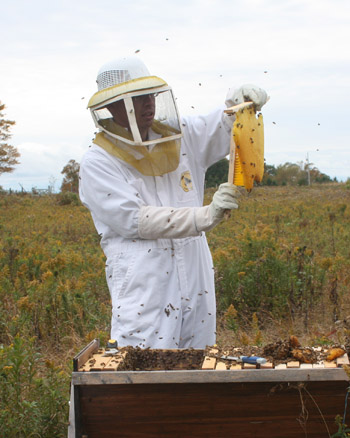 It’s all about the bees: we’re always moving forward with some new idea or possible modification to better help the bees and the hives. For example: of our first four top bar hives, we have three different designs, four different building methods and two types of top-bars. We’ve more or less settled on one design, but we keep our eyes open for ideas and are planning to run a field trial of different versions to see how they compare.
Honey production and hive products are not the primary focus for us. Yet, we are still a commercial apiary and have limited runs of raw honey for sale. Only the excess goodness that the bees provide is harvested. The wax is used in candles, lip balms and creams.
Not all of our hives are TBH’s, though. Honey is what pays the bills, and you just can’t beat a standard Langstroth for honey production. That doesn’t mean we’ve abandoned our principles, though. The hives do have frames, but where you’d normally see sheets of foundations wax, there’s just a starter strip. That helps keep the combs straight and inside the frames. That lets us work in the hive without making a mess of the comb when we need to inspect a frame. That also lets the bees build whatever size cells they want. If you do a Google search for cell size, you’ll find all kinds of arguing about what size of brood comb cell is “natural”. Standard foundation is around 5.2mm, but any number of other sizes are espoused. We don’t have the answer to that argument either, but we’ve seen a wide range of cell sizes in comb: as large as 5.5mm and all the way down to 4.7mm. Leave out the foundation and they’ll build whatever size cells they want. That’s as it should be.
Kids are the future
Teaching people about the lowly honeybee is vital as well. We love to talk about the bees and show people what we do. We’ve had visitors from all over Southern Ontario and Quebec and in 2010 we developed the requirements for a Scouts Canada Pack Speciality Badge in Beekeeping. So far, three Cub Packs have done the program and once we’re happy with it, we’ll be sharing it with the entire organization. Our kids are the future and the sooner they know how vitally important our insect friends are, the better off we’ll all be.